

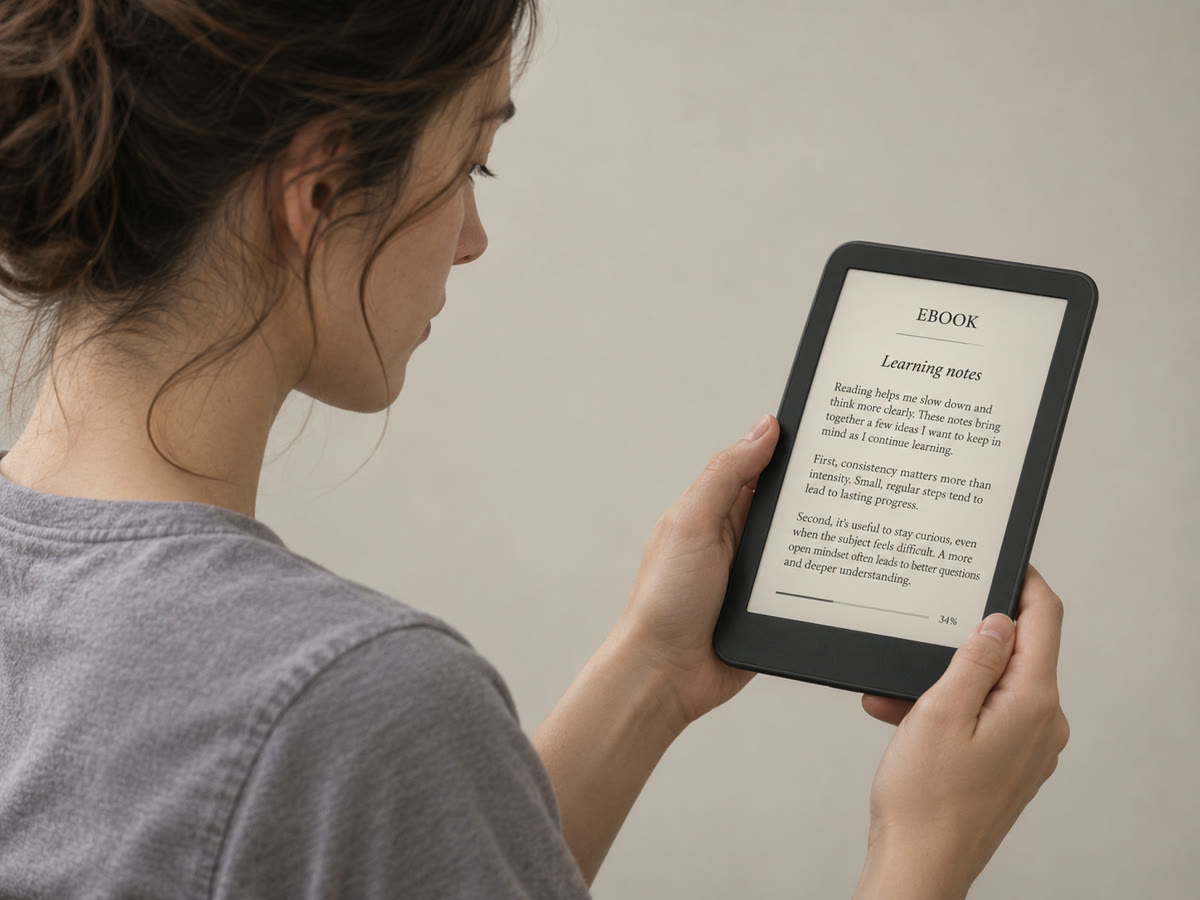
Ebooks can help you follow a subject in a clear order, read at your own pace and return to explanations when you need them. Their value grows when you turn an example into something you try yourself.
You save an article about a new skill. Then a video. Then a checklist. A week later, you have plenty of links and still do not know where to begin. A well-organised ebook can help by putting the explanations and examples into one reading path.
That does not make every ebook useful, or make reading a substitute for action. This guide explains where digital books can help, what to check before buying one and how to connect a chapter to a practical next step.
What is an ebook—and what makes one useful?
An ebook is a book or guide delivered in a digital format that you read on a compatible device. It might be a long-form publication, a focused practical guide or a reference you open when a particular question comes up. Some include worksheets or templates, but those are separate features to check in the product description.
A useful ebook does more than collect information. It gives you a route through a subject: what to understand first, which examples to study and what you could try afterwards. That structure can be valuable when your alternative is a folder of saved links with no clear starting point.
The format alone does not make the content trustworthy. A short, accurate guide that answers your question can be more useful than a large download filled with repetition. Look for a clear purpose, relevant examples and honest limits.
Six practical benefits of ebooks
1. Keep one subject together
A structured guide lets you follow a topic without constantly deciding which tab to read next. For example, an introduction to photography might explain light before exposure and composition. You can see how the ideas connect rather than collecting isolated tips.
2. Fit reading around the time you have
You can work through a suitable ebook in manageable sessions and return to the same chapter later. This makes it possible to build reading into a commute, a quiet evening or a short break. You still need attention; a spare five minutes may be better for reviewing one example than tackling a difficult new concept.
3. Carry a compact reference
Several digital guides can sit on one compatible device. Where the download and licence allow it, keeping a local copy can make reading possible without a continuous internet connection. Some services require an account or app, so confirm access requirements before buying.
4. Find an explanation again
A linked contents page, bookmarks or searchable text can help you revisit a useful passage. Features depend on the file and reading application. A scanned image-only PDF may behave differently from a properly structured ebook; “digital” does not automatically mean searchable or accessible.
5. Combine an explanation with an activity
A guide can place an example beside a prompt, checklist or worksheet. Reading about planning a project is one step; writing your own audience, deadline and deliverable makes the idea specific. Check whether the product actually includes those companions rather than assuming every ebook does.
6. Revisit material as your needs change
An explanation that felt abstract at first may become useful when you encounter the problem yourself. A guide to writing a brief, for example, can serve as a reference before your next project. Keep a note of the chapter and the question it helped you answer.
How ebooks can help with work and learning
At work, the most useful learning resource often addresses a concrete task: prepare a presentation, understand a tool or organise a small project. An ebook can provide vocabulary, a sequence and worked examples before you attempt the task yourself.
Suppose you want to create a short video with AI assistance. A focused guide could help you define the audience, write a brief, plan three scenes and prepare narration. You would then assemble the footage, captions and audio in an editor. The benefit comes from a coherent workflow, followed by practice and revision—not from simply owning a guide.
Our AI video workflow illustration shows that connection between an idea, a script and an edit. Tools and interfaces change, so check the guide’s date, scope and references when the subject depends on current software.
Useful reading for everyday life
Ebooks can also support ordinary decisions and interests. A cooking guide might explain one technique with a short shopping checklist. A home-organisation guide could help you work through one shelf instead of attempting an entire room. A language guide might provide a dialogue to practise aloud.
Choose a resource around the situation you actually face. “I want to cook three simple dinners” is a clearer reading goal than “I want to change everything.” Specific questions make it easier to recognise relevant advice and decide whether it works for you.
For health, nutrition, money or legal subjects, look for appropriate expertise and reliable sources. A general ebook cannot assess your individual circumstances or replace qualified advice. Avoid products that promise a cure, guaranteed income or an effortless transformation.

A guide can sit beside the task—not just on your reading list.
A starting point for creative interests
Creative hobbies can feel difficult to begin because there are so many possible tools and techniques. A useful beginner guide narrows the first step. For photography, that might mean practising one composition with the camera you already have. For writing, it might mean describing a familiar place before attempting a complete story.
Examples help you notice decisions you might otherwise miss: why a photograph has more space on one side, how a paragraph changes pace or what makes a simple layout readable. Then make something of your own and compare it with the principle you studied.
You do not need to finish every chapter before experimenting. Let the guide support the activity, and return when you have a more precise question.

Read one technique. Try it. Return with a more specific question.
PDF, EPUB and companion files: what to check
File format affects how a guide fits your device and your intended use. The W3C EPUB specification describes EPUB as a format for packaging digital publications. Reflowable EPUB content can adapt to a reader’s available space; some EPUBs instead use fixed layouts. The publication and reading software determine the experience.
| Format | Useful for | Check first |
|---|---|---|
| Preserving page layout, diagrams and printable worksheets. | Is text comfortable on your screen? Does the file support search and your accessibility needs? | |
| EPUB | Reading in a compatible ebook application, sometimes with adjustable layout. | Is it reflowable or fixed-layout? Does your reading app support the file? |
| Word or Excel companion | Editing a worksheet, template or planning tool. | Which application and version are required? Is a software licence included? |
KitFlair’s individual product listings explain the files and software requirements for the current collection. A comparison of formats is not a promise that every product is supplied in every format.
How to choose an ebook worth your time
Before you buy, work through this checklist:
- Define your question. What do you want to understand or do after reading?
- Check the audience. Is the guide written for a beginner, someone practising a skill or an experienced reader?
- Read the contents and preview. Look for a sensible order, clear explanations and relevant examples.
- Assess the source. Who is responsible for the content, and are important factual claims supported?
- Check currency. Software and other changing subjects may need recent instructions.
- Confirm access. Review file types, device and application needs, download instructions and usage rights.
- Read the purchase terms. Check the complete price and the refund and support information at checkout.
Price, page count and the number of bonuses are incomplete measures of value. Ask whether the resource helps you answer your particular question without unnecessary material.
A simple way to turn reading into action
Try this small cycle with your next guide:
- Ask: write one question before opening the chapter.
- Read: work through the relevant explanation and one example.
- Restate: explain the main idea in your own words.
- Try: use it in a small task you can complete.
- Review: note what happened and what you need to revisit.
From “learn AI video” to a first draft
Question: How can I explain one useful idea in 30 seconds?
Action: Draft a short script and three-scene plan, then make a rough edit.
Review: Can someone understand the main idea without extra explanation?
Our free action-planning exercise lets you write a topic, one small action and a time to try it, then download your note. It is a local planning tool, not an AI assessment or a submission for feedback.
Find one useful idea.
Make a small first attempt.
Notice what you would change.
When a different learning format may suit you better
An ebook is one option. If you need to see a precise hand movement or hear pronunciation, video or audio may explain that part more clearly. If you need personal feedback, a tutor, course or supervised session may help. Some tasks require a combination of formats.
Paper may also feel more comfortable for long reading sessions. Choose the medium that helps you work with the material. An ebook’s convenience does not mean it is automatically better for understanding or remembering every subject.
Common questions about ebooks
Can ebooks help me learn a new skill?
They can provide structure, explanations and examples. Developing the skill also requires practice and, for some tasks, feedback or supervision. Choose a guide that gives you a sensible starting point and activities relevant to your goal.
Can I read an ebook on my phone?
Many ebooks can be opened on a compatible phone application, but readability depends on the file and layout. A detailed fixed-page PDF or spreadsheet may be more comfortable on a larger screen. Check the product’s requirements.
Do all ebooks include worksheets?
No. Worksheets, templates, audio and other companions are included only when the listing says so. Confirm exactly which files you receive and whether the necessary software is supplied.
Can I share a purchased ebook with a friend?
That depends on the licence. KitFlair’s standard purchase licence does not permit redistribution of the purchased files. Read the copyright and permitted-use guidance or ask about the access you need.
What if I cannot download my purchase?
Check your receipt and the checkout platform’s access instructions. For a KitFlair purchase, email support@getkitflair.com with your product and order reference. Our Terms & Conditions explain the standard no-refund policy, download assistance and mandatory-rights exceptions.
Choose one useful question to start with
An ebook can give a subject a clear shape and keep useful explanations within reach. Its practical value depends on the quality of the material, whether it fits your needs and what you do with the ideas.
Start with one question. Find a suitable guide. Read a relevant section and try something small. You can always return with a better question once you have experience to connect it to.
About this guide
Prepared with AI assistance for KitFlair. The practical scenarios are illustrative examples, not customer results or a claim that every subject mentioned is currently sold by KitFlair. Product listings describe the current collection.
Format reference: W3C EPUB 3.3 specification. Reading features vary by publication and application.